 |
Caroline Fawkes
About My Practice |
|
|
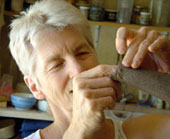
I was originally trained as an art historian (Courtauld Institute of Art) and subsequently taught fine art students in London for 20 years (Central St Martins).
By the time I started making hand-built ceramics in the 1990s, I had retrained and was working as a psychotherapist. Exploring clay helped me to integrate these two different periods of my life.
In 2003 I moved from London to rural France and set up my own ceramics studio (Dragon Ceramic), later developing handbuilding courses with Raku firings (2007-13).
These were intensive week-long residential courses based on the tutorial principle: I would help students to develop their ideas and realize their own projects, by assisting them individually in discovering appropriate techniques. There is a slideshow recording aspects of this project in the archive section of this site.
My own work started out from hand-built sculptural vessel forms, but has evolved as I experimented with different techniques, materials and firings. In principle my work is abstract. It is often driven by curiosity about where technical experiment will lead me, but is inflected by my fascination with my new environment in rural France, with geological formations, and particularly with natural and psychological processes. I am manifestly drawn towards imagery of riotous growth and precarious equilibrium, but this is not so much a conscious choice as something that emerges through the process of working.
I use a variety of clay bodies, usually grogged stonewares of different colours and origins, but also porcelain paperclays. Extraneous material such as glass may be included in the work, or preformed in the kiln and integrated at a later stage. Much of my work requires multiple firings including reduction firing in a gas kiln.